SaaS positioning: decide it, then make it visible.
Most B2B SaaS companies have a position worth owning. What they rarely have is a decision everyone agrees on, written down and put where buyers see it. This guide shows you how to make that decision, turn it into messaging for each buyer, run a positioning workshop and check whether your homepage actually says it.
What SaaS positioning actually means
SaaS positioning is the decision underneath everything you say about your product. It settles who the product is for and who it isn't for, what those buyers would use if you didn't exist, and the one claim you can make that nobody else in your category can.
Jo Ring's working definition: positioning is deeply understanding a real need, then solving it with a clear position and a passionate point of view.
Each part of that definition does work. A real need is one your buyers already feel, so you aren't spending the first half of every sales call convincing them they have a problem. A clear position is a choice about who you serve. A point of view means you're prepared to say what the alternatives get wrong.
B2B positioning has one extra test: it has to survive a group decision. A champion has to explain you to colleagues, someone else has to approve the spend, and for a funded company, investors need the same story to make sense. If each of those people hears a slightly different company, the positioning hasn't been decided yet.
If you want the full method, April Dunford's Obviously Awesome breaks positioning into five components: competitive alternatives, unique attributes, value, best-fit customers and market category. The framework later in this guide shares its starting point, real alternatives rather than an imagined market, and adds a homepage check at the end.
Why most SaaS positioning fails
3 in 4
funded B2B SaaS homepages already have strong positioning. It's buried where nobody sees it.From Jo Ring's review of 500+ funded B2B SaaS homepages.
That finding changes where to start. Most teams don't need a new idea. They need to choose between the ideas they already have and move the strongest one to where buyers read. Positioning usually goes wrong in one of three ways.
It's assumed, not decided
The positioning lives in a founder's head or a deck from two fundraises ago. Nobody chose it against the alternatives, so nobody can defend it when a deal gets hard or a competitor launches something similar.
Co-founders describe it differently
Ask each founder what the company does and who it's for, separately. If the answers differ, your sales team, your website and your investors are each hearing a different company, and buyers notice.
The website talks to everyone
Nobody wants to exclude a prospect, so the hero describes a category and lists features. Your best-fit buyer can't see themselves in it, and the strongest thing you could say ends up halfway down the page.
All three have the same fix: make the decisions on purpose, write them down and check that your homepage says them.
How to decide your positioning in three calls
Positioning becomes useful when it's a set of decisions someone has signed off. These are the three that matter most, in the order to make them. Each one narrows the next.
Decide who you're for, and who you're not
Describe your best-fit customer specifically enough that sales could use it to disqualify a lead. Look at the customers who bought quickly, stayed and got the most from the product, and find what they have in common.
Then write down who you're not for, and why. This is the line most teams flinch at, and it's the one that makes everything after it sharper.
Find the one claim only you can make
List what those buyers would do if you didn't exist, including doing nothing or carrying on with a manual workaround. Write the claim you'd make against each alternative, then pressure-test it: could a competitor put the same sentence on their homepage unchanged? If they could, the claim isn't yours yet.
If you have more than one credible option, compare them before you commit. Our Positioning Durability Model does this formally, testing two to five positioning options against market conditions and competitive density.
Write messaging for each buyer
One claim, said differently to each person in the deal: what the champion needs to hear to sell you internally, and what an investor needs to see to believe the story. Use your buyers' words rather than your own. Sales and customer success calls are the richest source, which is why our Overheard tool works from call transcripts to surface the exact language buyers use for the problem, the pain and the solution.
A SaaS positioning framework you can actually use
Most positioning templates let you fill a blank with something vague and move on. This worksheet adds the two columns they skip: the evidence behind each answer, and the test the answer has to pass before you go to the next row. Work through it in order. Each row depends on the one above it.
Best-fit customer
- The question
- Who gets the most value from you, fastest?
- Evidence to bring
- Your best current customers and recent wins
- It passes when
- Sales could use it to disqualify a lead.
Who you're not for
- The question
- Who should you turn away, and why?
- Evidence to bring
- Churned accounts, painful onboardings, lost deals
- It passes when
- You can name a real prospect it rules out.
Alternatives
- The question
- What would buyers do if you didn't exist?
- Evidence to bring
- Call transcripts and lost-deal notes
- It passes when
- The list includes doing nothing or a workaround.
The one claim
- The question
- What can you say that no alternative can?
- Evidence to bring
- Product capabilities and competitor homepages
- It passes when
- A competitor couldn't use the sentence unchanged.
Proof
- The question
- Why should a buyer believe the claim?
- Evidence to bring
- Results you're allowed to publish, product evidence
- It passes when
- Every part of the claim has something you can show.
Outcome
- The question
- What changes for the buyer?
- Evidence to bring
- Customers describing results in their own words
- It passes when
- It describes the buyer's result, not a feature.
Messaging by buyer
- The question
- What does each person in the deal need to hear or see?
- Evidence to bring
- Objections from champions and approvers on calls
- It passes when
- Every message points back to the same claim.
Then compress it into one sentence
Once every row holds up, you can summarize it. The familiar version is Geoffrey Moore's positioning statement template from Crossing the Chasm:
For [target customer] who [statement of need], [product name] is a [product category] that [statement of benefit]. Unlike [primary competitive alternative], our product [statement of primary differentiation].
Treat the sentence as a record of decisions you've already made. Filled in first, it captures whatever the person holding the pen already believes, which is how teams end up with positioning that's assumed rather than decided.
Positioning vs messaging: where the words come in
Positioning is what you decide. Messaging is how each buyer hears it. When a team rewrites its homepage every quarter, it's usually trying to solve a positioning problem with words, and no amount of copywriting settles a decision nobody has made.
Jo's working definition of messaging: understanding what people want and making them feel understood.
A messaging framework in four moves
Good messaging walks the buyer from their problem to your offer without skipping the parts they've already lived through.
The problem
Name it the way your buyer would, in the words they use on calls.
What they've tried
Show you know the workarounds they already run and why those wear thin.
The solutions out there, and where they fall short
Be fair about the alternatives, then specific about the gap they leave.
Your offer as the one answer
Connect your claim to what this buyer cares about, so it means something to them.
Run it once for each buyer
In B2B SaaS, run the sequence separately for each person in the deal. The champion needs a version they can repeat to colleagues. An investor needs to see the same claim as a position that holds up in the market. The problem and the alternatives change with the reader. The claim stays the same, and if it doesn't, go back to the framework.
How to run a positioning workshop
A positioning workshop is where positioning stops being assumed. Its job is to leave the room with a written decision that the people who sell, build and support the product have all agreed to.
Before the session
- Ask each founder and leader to write, separately, what the company does and who it's for. Don't share the answers until the session starts. The differences are your agenda.
- Gather evidence: recent sales and customer success call transcripts, notes on deals you won and lost, and the homepages of the alternatives buyers compare you with.
- Score your current homepage hero with the free Hero Score so you start from how your positioning reads today.
Who should be in the room
The people who make the decision and the people who hear buyers every day: the founders, whoever leads sales, customer success, product and marketing. Keep the group small enough to decide. If marketing runs it alone, sales will treat the result as a marketing document.
The agenda
Compare the founder statements
Read the pre-work answers side by side. Agree on where they differ and why.
Decide the best-fit customer
And who you're not for. Write both down before moving on.
Map the alternatives
Everything a buyer could do instead, including doing nothing.
Draft the one claim
Test it against each alternative. Could any of them say it too?
Check the proof
Cut any part of the claim you can't back up with something you can show.
Draft messaging by buyer
Run the four-move sequence for the champion and for anyone who approves or invests.
Write it down and assign owners
Name who updates the homepage, the sales deck and the investor narrative, and by when.
After the session
Rewrite the homepage hero first, then score it again. Update the sales deck next, then the investor narrative. Positioning that lives only in a workshop document hasn't reached the people who need to hear it.
Want someone outside the company to run it? The Throwing Hands Positioning Sprint takes four weeks and about 3 to 4 hours of your team's time each week. Then our positioning-led content engine gets the new position seen and cited.
Score your homepage hero on five dimensions
Your homepage hero is often the first place a buyer meets your positioning, and the place it most often gets buried. The Hero Score measures a hero across five dimensions. Use them as a checklist after any positioning work, and again whenever someone rewrites the headline.
ICP Specificity
Could your best-fit buyer tell from the hero that this is for them?
Outcome Clarity
Does it say what changes for the buyer, rather than what the product does?
Plain Language
Would a buyer understand it without knowing your category's jargon?
Ownability
Could a competitor put the same words on their homepage unchanged?
Discoverability
Does it use the words buyers search for, so search engines and AI answers can find and repeat it?
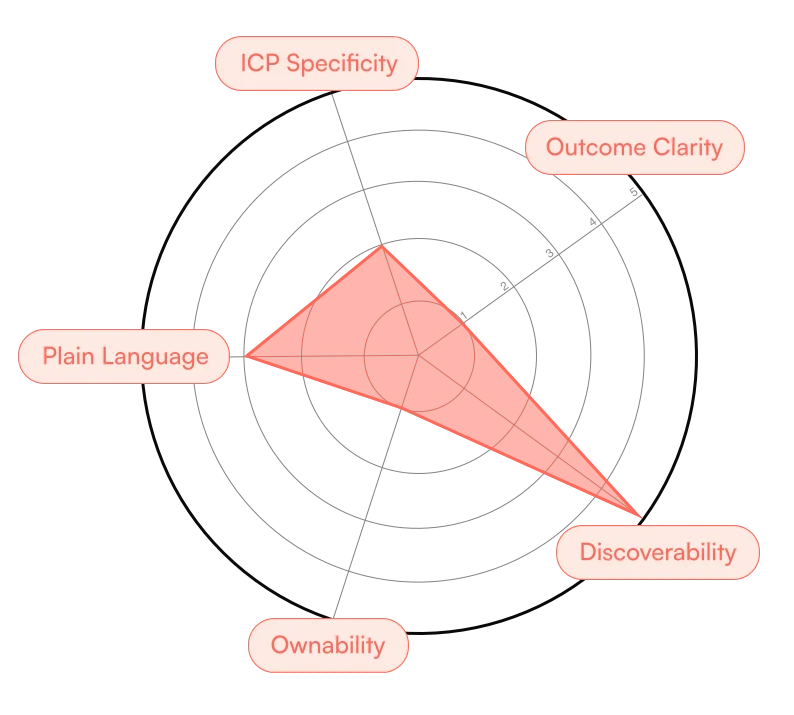
Free, instant, no signup. Or grade your SaaS positioning in 2 minutes with an 8-question quiz.
Discoverability now reaches beyond Google. Buyers ask AI assistants which tools to consider, so a clear, specific claim is also what gets repeated in AI answers. Once the hero holds up, the same claim should run through your content. If you're weighing who should write it, our guide to choosing a SaaS content marketing partner covers the trade-offs.
SaaS positioning questions, answered
Sources and further reading
- April Dunford, Obviously Awesome
The five components of positioning referenced in this guide.
- Geoffrey Moore, Crossing the Chasm
Origin of the positioning statement template.
- The Hero Score
Our free homepage hero score across five dimensions.
- Grade Your SaaS Positioning in 2 Minutes
An 8-question positioning quiz.
- 5 Signs Your SaaS Positioning Is Costing You Deals
A short checklist from Throwing Hands.
The 3 in 4 figure comes from Jo Ring's own review of 500+ funded B2B SaaS homepages.