How the Hero Score judges your homepage
We score the copy at the top of your homepage against five questions your buyer is asking, then compare it with your top competitor's.
What the score reads, and why it starts with your hero
The Hero Score rates the copy at the top of your homepage: the eyebrow, the headline and the subheadline. That's all it reads. Design, product screenshots, logos and everything below the hero sit outside the score.
We start there because the hero is the shortest public version of your positioning. A buyer reads it before anything else and decides from it whether to keep reading. If the decisions behind your positioning are still vague (who you're for, what changes for them, why you over the alternatives), the hero is where that shows first.
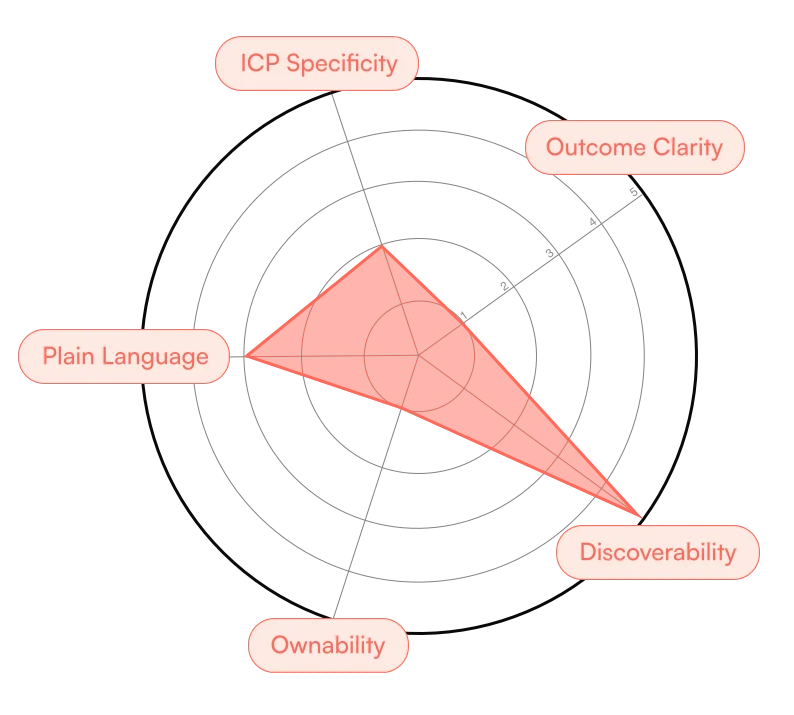
We built the score around five questions we ask of every hero. Each question gets a score from 1 to 5 and a short reason. Plotted together, the scores make your Hero Map.
3 in 4
Five questions your buyer is asking
Each dimension is a question a buyer is answering, often without noticing, while they read your hero. These are the questions, word for word, as the tool asks them.
ICP Specificity
“Who exactly is this for – and who is it definitely not for?”
Whether a buyer can tell from the hero alone that the product is meant for someone like them. A hero that tries to include everyone gives nobody that signal.
Outcome Clarity
“What changes in my life or work if I use this?”
Whether the hero says what's different for the buyer once they use the product, in terms of their own work, rather than listing what the product does.
Plain Language
“Would a customer actually describe what they need this way?”
Whether the words match how buyers describe the problem themselves. Category jargon and invented terms make a buyer translate before they can decide.
Ownability
“Could any other company say this – or is it yours alone?”
Whether the claim belongs to you. If a competitor could put the same sentence on their homepage unchanged, it gives a buyer no reason to choose you.
Discoverability
“When buyers search for what you solve, does that search lead to you?”
Whether the hero uses the words buyers use when they search, or ask an AI assistant, for help with the problem you solve.
Where heroes usually fall short
Across the 500+ funded B2B SaaS homepages we've scored, Ownability, ICP Specificity and Outcome Clarity are the dimensions that score lowest most often. Discoverability and Plain Language routinely score high: heroes tend to use the keywords buyers search for, in plain words. So a hero can be easy to find and easy to read, and still not say who it's for, what changes or why it's yours.
One scale, five verdicts
Each dimension gets a whole number from 1 to 5. The tool averages the five scores, and the average decides the verdict. If you prefer a total, add the scores instead: the same bands run from 5 to 25.
The rubric defines specifically what earns a 1, 2, 3, 4 or 5 on each of the five dimensions. So a hero's score only changes when its copy changes, which is what makes a before-and-after or a side-by-side comparison fair.
Invisible
Average 1.0 to 1.45 to 7 out of 25
“Your positioning needs foundational work. There's a big opportunity to build something sharp from here.”
Origin Story
Average 1.6 to 2.48 to 12 out of 25
“You have the raw ingredients – now it's time to sharpen your positioning into something that breaks through.”
Contender
Average 2.6 to 3.413 to 17 out of 25
“You have a solid foundation. A few targeted improvements will unlock your next level of growth.”
Heroic
Average 3.6 to 4.418 to 22 out of 25
“Your positioning is strong. Focus on consistency and amplification to own your category.”
Legendary
Average 4.6 to 5.023 to 25 out of 25
“Your positioning is crystal clear. You're set up to dominate your category.”
A decent average can hide one weak dimension. Read the five scores before you read the verdict.
How to benchmark your hero against a competitor
Your buyer reads your competitor's homepage too. We show you where yours wins, and where theirs does.
Score your own hero first
Paste your eyebrow, headline and subheadline exactly as they appear on the live homepage. Score what buyers see today, not the version waiting in a draft.
Score the company you lose deals to
Pick the competitor whose name comes up most in lost deals, which isn't always the biggest name in your category. Paste the same parts of their hero, so both are judged on the same amount of copy. You can add them before you score or straight after your result.
Compare dimension by dimension
The tool draws both heroes on one Hero Map and lists every dimension with both scores and who has the edge. Start where you trail. Two heroes can land on the same verdict and still win on different dimensions, and those differences tell you what to rewrite.
The scorecard, if you'd rather score by hand
Working through it with your team? Use the same five questions. Score each from 1 to 5 for both heroes, then give the edge to the higher score, or mark it level.
ICP Specificity
Who exactly is this for – and who is it definitely not for?
- You
- /5blank
- Competitor
- /5blank
- Edge
- blank
Outcome Clarity
What changes in my life or work if I use this?
- You
- /5blank
- Competitor
- /5blank
- Edge
- blank
Plain Language
Would a customer actually describe what they need this way?
- You
- /5blank
- Competitor
- /5blank
- Edge
- blank
Ownability
Could any other company say this – or is it yours alone?
- You
- /5blank
- Competitor
- /5blank
- Edge
- blank
Discoverability
When buyers search for what you solve, does that search lead to you?
- You
- /5blank
- Competitor
- /5blank
- Edge
- blank
Free, no signup, results in about 20 seconds. One competitor per run.
What strong and weak answers sound like
These hero lines are made up for this guide and belong to no real company. Each pair describes the same kind of product two ways, so you can hear what each question is listening for.
ICP Specificity
Who exactly is this for – and who is it definitely not for?
“The platform for growing businesses.”
“Expense management for finance teams running more than one legal entity.”
The weak line fits almost any buyer, so no buyer feels it was written for them. The strong line names a team and a situation, and a company with a single entity can see straight away that it isn't the target.
Outcome Clarity
What changes in my life or work if I use this?
“AI-powered insights for revenue teams.”
“Know which deals will slip before your forecast call.”
The weak line describes the product. The strong line describes a moment in the buyer's week that goes differently once they use it.
Plain Language
Would a customer actually describe what they need this way?
“A composable, unified orchestration layer for omnichannel engagement.”
“Answer every customer message from one inbox, whether it starts in email, chat or text.”
Nobody goes looking for an orchestration layer. The strong line uses the words a support lead would use to explain the problem to a colleague.
Ownability
Could any other company say this – or is it yours alone?
“The all-in-one platform trusted by modern teams.”
“Contract review that checks every new contract against the clauses your legal team has already approved.”
Swap in a competitor's logo and the weak line still works for them. The strong line rests on something specific to this product, so a rival can't use it without changing the sentence.
Discoverability
When buyers search for what you solve, does that search lead to you?
“Reimagine how your people work.”
“Staff scheduling software for hospitals and care homes.”
The weak line holds nothing a buyer would type into a search bar or ask an AI assistant. The strong line matches the words a hospital operations lead would use to look for help.
Hero Score questions, answered
It measures how clearly your homepage hero states your positioning. The hero is the eyebrow, headline and subheadline at the top of your homepage. The score rates that copy on five dimensions: ICP Specificity, Outcome Clarity, Plain Language, Ownability and Discoverability.
Yes. It's free, needs no signup and returns your results in about 20 seconds.
Each dimension gets a whole-number score from 1 to 5, with a short reason. The five scores are averaged, and the average sets the verdict: Invisible (average 1.0 to 1.4), Origin Story (average 1.6 to 2.4), Contender (average 2.6 to 3.4), Heroic (average 3.6 to 4.4), Legendary (average 4.6 to 5.0).
Yes, as long as the copy is the same. The rubric defines specifically what earns a 1, 2, 3, 4 or 5 on each of the five dimensions, so a hero's score only changes when its copy changes.
Across the 500+ funded B2B SaaS homepages we've scored, Ownability, ICP Specificity and Outcome Clarity are the dimensions that score lowest most often. Discoverability and Plain Language routinely score high: heroes tend to use the keywords buyers search for, in plain words.
Add your top competitor's name and hero copy when you score your own, or score them straight after your result. The tool draws both heroes on one Hero Map and shows, for each dimension, who has the edge or whether you're level.
The tool compares one competitor at a time. To benchmark against another, run the score again with that competitor's hero and note each result on the scorecard in this guide.
No. It reads only the hero copy you paste in. Design, imagery, product screenshots and everything below the hero are outside what it scores.
Jo Ring, B2B positioning and messaging strategist at Throwing Hands, with 20+ years in marketing, starting as a copywriter. We've used the Hero Score on 500+ funded B2B SaaS homepages, and in more than 3 in 4 of them we found buried gold: strong positioning sitting below the hero instead of in it.
You can ask for the full diagnostic, which is emailed to you as a PDF. If the scores point to a positioning problem rather than a wording problem, book a free 30-minute Positioning Discovery call with us.